EXPLORING DARTMOOR'S ARCHAEOLOGY
IN THE SPRING
WALKING WITH DR TOM GREEVES, MA, PhD
MONDAY 19 MARCH 2012 to SATURDAY 24 MARCH 2012
and
MONDAY 23 APRIL 2012 to SATURDAY 28 APRIL 2012
Springtime is the best season for exploring the wonderful extent of Dartmoor's archaeology as the new annual vegetation has not yet obscured features, and all subtleties are revealed. Some of the best-preserved prehistoric cultural landscapes in the world can be seen, intermixed with probably the best landcape remains in Britain relating to tinworking, as well as evidence of stonecutting, peat cutting, military activity and hill farming from medieval times onwards. Ancient tracks and crosses will also be explored.
ADVANCED BOOKING ONLY. Walks can be booked on a daily basis (£15 per head per day Mon,Tues, Thurs, Fri, Sat; £8 on Wednesdays) or at a special rate for all six days of £75 per head.
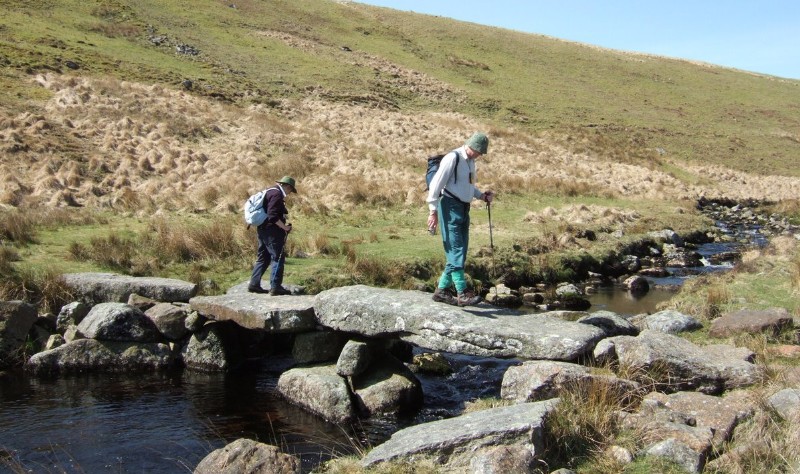
Participants will be required to make their own way to and from the starting points and to bring a packed lunch, warm waterproof clothing and stout walking boots or shoes. Ordnance Survey Outdoor Leisure 1:25000 (2 ½ -inch) Map 28 Dartmoor is highly recommended. The walking will be at a gentle pace with plenty of stops to view features of interest, but much of it will be over rough moorland and occasionally streams will need to be crossed, so a moderate degree of fitness is required. Walks will finish by 5pm at the latest unless otherwise stated. DOGS ARE WELCOME BUT MUST BE KEPT ON A LEAD AT ALL TIMES (for the protection of livestock, ground-nesting birds and the comfort of the group, and to conform with the Countryside & Rights of Way Act 2000). Please do not use mobile phones when on the walk itself. Walks may be modified due to weather or other reasons at the discretion of the leader. Please note participation is entirely at your own risk.
Dr Tom Greeves (www.tomgreeves.org), has explored Dartmoor for more than 40 years and has written and lectured extensively about its archaeology and history of all periods. He was trained as a prehistorian at Edinburgh University and his PhD at Exeter University was on the early modern Devon tin industry. From 1990 he has practised independently as a cultural environmentalist. Since 1998 he has been Chairman of The Dartmoor Society (www.dartmoorsociety.com). He also conducts 'Discovery Holidays' on the Isles of Scilly (www.scilly discoveryholidays.co.uk) which in 2012 will run from 12-19 May (fully booked), 9-16 June, and 15-22 September.
Tel: 01822 617004; Email: tomgreeves@btconnect.com
*****
PROGRAMME OF WALKS
19 - 24 MARCH 2012
Monday 19 March - Farms, tinworks and prehistory of the Deancombe valley. Meet: 10.30am carpark S of Norsworthy Bridge, at SX 569693, at the upper end of Burrator reservoir. Length: 8 km/5 miles. Nearest WC at Burrator Lodge on the road round the reservoir at SX 551685 (note - the WC by the reservoir dam is not open).
This is a gentle introduction to the wonders of Dartmoor archaeology. Our focus will be the stunning valley of the Deancombe Brook (also known as the Narrator Brook), a tributary of the R. Meavy. We shall take a detailed look at the sites of three ruined farms (Middleworth, Deancombe, and Combeshead) all of which are documented from the medieval period until the early 20th century, when they were abandoned. Several storage 'potato holes' or tinners' caches will be seen. On our route, there are numerous interesting features relating to tinworking etc, including tin mills (and possible tin mills), leats and reservoirs. The scale of medieval tinworking in the upper reaches is hugely impressive. On the lower flanks of Eylesbarrow are prehistoric settlements and a boundstone, unmarked by the Ordnance Survey, with beautifully cut letters. Part of the Eylesbarrow prehistoric reave will be followed south-westwards, and cists and cairns nearby will be visited. The route will then take in Outcombe mine, farm and tin mill, and will return to the cars via Roughtor plantation where recent work has been done on surveying and clearing tinworking sites.
Tuesday 20 March - Wheal Caroline, Hurston Ridge, West Vitifer Mine and King Arthur's Oven. Meet: 1030am at small car park on the E side of Statts Bridge SX 668806. Length: 10 km/6 miles. Nearest WC in Postbridge carpark.
Here we are by the disused Birch Tor & Vitifer Mine leat, 7 miles in length and probably at least 200 years old. Our route will first explore the site of a pumping wheelpit of 19th century Wheal Caroline tin mine and then the site of Caroline Farm, before striking over to Hurston Ridge with its fine stone row, reaves and cairns. Down the Metherall Brook to the Heath Stone, then following the western edge of enclosed land we make our way to the R. Bovey (called North Walla Brook on OS maps) and 'Hurston Castle', then upstream to explore the wheelpit, dressing floor and adits of West Vitifer Mine and Bushdown before visiting the misplaced King's Oven (a prehistoric enclosure). We then ascend Water Hill to see a site probably visited by monks of Laon in AD 1113 - King Arthur's Oven - Dartmoor's answer to a Scillonian and West Penwith entrance grave. Finally we see the shaft and whim platform associated with the wheelpit we saw at the start of our walk.
Wednesday 21 March - Fingle Bridge, Cranbrook Castle and Fingle Mill. Meet: 1030am at Fingle Bridge carpark on S side of river SX 744898. WC in carpark. Distance 3.2.km/2 miles (although the distance sounds small there is a steep ascent and descent up and down about 650 ft/200m to Cranbrook Castle!). The walk will finish by 1pm.
We start close by the site of Fingle Mill - a corn mill, perhaps of ancient origin, which burnt down in about 1890. Iron slag found here suggests iron smelting may have also taken place. Photographic evidence will bring the mill to life. The ancient packhorse bridge across the River Teign indicates what must once have been a very important route, part of which we will follow steeply up through the woods, sympathising with any poor laden packhorse! Historically, these woods were extensively used for charcoal production and the stripping of bark (for tanning). En route we will pass a stone with an inscribed cross, traditionally said to be marking the grave of a soldier in the Civil War of the 1640s. Cranbrook Castle is one of three remarkably impressive prehistoric fortified sites overlooking the Teign valley. It is possibly unfinished but stone ramparts and ditches are clearly visible.
Thursday 22 March - The moorland Yealm and Erme. Meet: 10.30am, parking just beyond the moorgate at New Waste SX 625611, 1 ½ miles NE of Cornwood. Length: 13 km/8 miles. Nearest WC at crossroads in centre of Cornwood village.
Passing prehistoric settlements etc, we shall head northwards to the very attractive rocky combe of Yealm Steps. Here are two well-preserved tinners' blowing mills and associated artefacts of probable 16th century date, one of them the first to be identified archaeologically in the 1860s. From the head of the Yealm we shall strike eastwards across to Knackersmill Gulf and pick up the longest known (2 ½ mile) prehistoric stone row in the world (?) and follow it south to its terminal at The Dancers' stone circle. Continuing southwards and passing a fine cist, we shall climb Staldon to view the magnificent stone row, Hillson's House and various cairns, before descending back to New Waste.
Friday 23 March - Rippon Tor and Haytor. Meet: 1030am Hemsworthy Gate, SX 741761. Length: 10 km/6 miles. Nearest WC at lower Haytor carpark or in Widecombe.
First to the prehistoric settlement and fields with the intriguing name of Foales Arrishes. Then southwards to cist and cairns on Blackslade Down and Wittaburrow. Across Blackslade Ford and the site of New House before climbing to the top of Rippon Tor with its fine cairns, and unfinished cross. From here to a remarkable tinners' openwork on Bagtor Down, followed by an exploration of Bagtor Mine etc, Crownley Parks, Pinchaford Ball, and back via Haytor and Saddle Tor and the site of one of only two 19th century steam pumping engines on moorland Dartmoor, close to Hemsworthy Gate.
Saturday 24 March - Sourton iceworks, a prehistoric complex, the Rattlebrook peatworks and the King Way. Meet: 1030am beside tarmac track to Prewley Waterworks SX 545910, on E side of A386, 1 mile NE of Sourton. Length: 16 km/10 miles. Nearest WC not known, but perhaps in Lydford!
Our route will take us first to a remarkable but failed 19th century attempt to establish an ice factory on the north-west slopes of Dartmoor, and then to a cluster of fascinating prehistoric features on a watershed. These have mostly only been recognised since the 1960s and include a stone circle and an enigmatic line of small cairns. There is also a puzzling and substantial ditch, possibly prehistoric. On to Corn Ridge where we visit cairns etc linked to 13th century Bishop Bronescombe of Exeter, who had a lucky escape from the Devil here. High above the West Okement valley we shall visit Stenga Tor and Kitty Tor before descending westwards to the site of the 19th and 20th century Rattlebrook Peat Works. Following its purpose-built railway track we shall investigate cairns on Great Nodden and then a newly discovered medieval cross on the King Wall. Heading northwards past more cairns we shall follow the King Way back to Sourton Tors and then descend to the cars at Prewley.
23- 28 APRIL 2012
Monday 23 April - Ringmoor Down, Ditsworthy and the Upper Plym. Meet: 1030am at carpark by Brisworthy Plantation. SX 554666. Length: 13 km/8 miles. Nearest WC at Yelverton.
Ringmoor Down has many fascinating prehistoric features including a fine stone circle, stone row and cist. Each of these will be visited and also a medieval settlement at the head of Legis Lake (its old name was Yaddabrook - a name element first recorded in 1031). From here our next destination will be Legis Tor itself, with warrener's vermin traps and prehistoric hut circles closer to the river. Continuing up the Plym we come to Ditsworthy Warren House, a farm site documented in the 15th century (and also the scene of filming some of 'War Horse'), and then the amazing prehistoric complex of rows, cairns etc at Drizzlecombe. The Plym will be followed as far as Plym Steps and the tautologous Hartor Tor, viewing tin mills etc en route before striking across part of the remains of early 19th century Ailsborough tin mine to its smelting house (operating 1822-1831), and back via the medieval settlements of Whittenknowles and Gutter Tor and round the northern flank of Ringmoor, following the great Eylesbarrow prehistoric reave back to the cars.
Tuesday 24 April - Harford and Ugborough Moors. Meet: 1030am Harford Moor Gate, SX 644595. Length: 16 km/10 miles. Nearest WC in Cornwood or Ivybridge.
Heading southwards we first visit the site of a tin mill below the Butter Brook reservoir, then make our way to a mid-19th century rifle range on Weatherdon Hill before reaching the cairns by Black Pool. From here we go to two neolithic chambered tombs at Cuckoo Ball and Butterdon, before climbing to Main Head, an enigmatic building and Spurrells Cross. Past Hobajon's Cross to the great stone row on Piles Hill, noted in the early 19th century by John Andrews but forgotten and only rediscovered in the 1960s. Down to Glasscombe Corner and the prehistoric features between the West and East Glaze. Then to the head of the latter stream before following the great reave to the enormous cairns at Three Barrows, then turning south to Sharp Tor and the west flank of Piles Hill back to the moorgate.
Wednesday 25 April - Sampford Spiney. Meet: 1030am at carpark on Plasterdown at SX 522727. Nearest WC in Tavistock. Length: 7 km/4 ½ miles. The walk will end by 1pm.
This half-day excursion, partly along lanes, explores part of a major medieval N-S route on the western side of Dartmoor, past Watery Ford (with its highly radioactive water supply!), an early Christian inscribed stone discovered in 1997 near Sampford Barton, and Huckworthy Cross. The hamlet of Sampford Spiney itself will be visited and, if time allows, a 19th century granite quarry on the slopes of Pewtor.
Thursday 26 April - Crockerntor, Wistman's Wood and Brown's House. Meet: 1030am at carpark on N side of the road opposite the Two Bridges Hotel, SX 609751. Length: 13 km/8 miles. Nearest public WC at Princetown.
First to the must-see open air location of the Great Courts of Devon tinners on Crockerntor, held here on thirteen documented occasions between 1474 and 1710. This extraordinary gathering, attended by hundreds of people, was an assembly for enacting statutes governing the administration of the tin industry. Then along the fine ridge and a succession of tors, crossing prehistoric reaves. Search will be made for the stone row between Longaford and Higher White Tor. From the Cherrybrook we strike north-westwards to the most remote and remarkable of all Dartmoor's early 19th century new foundations - Brown's House - from which dairy products were taken to the Napoleonic war prison at Princetown. A nearby tinners' lodge will also be seen. The return route will follow the West Dart downstream to the site of the warrener's house and pillow mounds at the north end of Wistman's Wood, the most famous of all three of Dartmoor's indigenous oak woodlands. On the hillslope above the wood are numerous prehistoric hut circles.
Friday 27 April - Round Pound, Shovel Down, the Southill Leat. Teignhead and Manga Farms. Meet: 1030am at grass carpark just beyond Round Pound at SX 663868. Length: 11 km/7 miles. Nearest WC in Chagford.
Our first inspection will be of the Round Pound, a magnificent prehistoric house within a circular enclosure, excavated by Aileen Fox in the 1950s, all set within a marvellously preserved field system of parallel reaves and droveways. We will then make our way to a small tinners' adit near Batworthy Corner before exploring the highly complex prehistoric rows etc at Shovel Down. From the Longstone we will strike westwards to the medieval embankment of the South Hill Leat (constructed in the 1490s) then on to Teignhead Clapper and the ruins of a tinners' blowing mill, before Teignhead Farm itself, founded in the early 19th century. Then northwards to Manga Farm and Manga Falls before exploring tinworks on the North Teign and heading back to Batworthy Corner.
Saturday 28 April - The top of the world - Dartmoor's highest ground. Meet: 1030am at carpark on W side of military road, SX 597922, NE of Rowtor. Length:10 km/ 6 miles. Nearest WC in Okehampton.
Our route will follow contours or climb gradually, so we will be largely (almost!) unaware of the fact we will have eventually reached 2038 ft/610m above sea level - the highest ground on Dartmoor and southern England. First we skirt Rowtor and see some military features (including a target railway) on its south side. Then round the northern flanks of West Mil Tor and Yes Tor to a somewhat amorphous but probable prehistoric cairn, recently identified. Then to Fordslands Ledge, with military hut and prehistoric chambered (?)cairn, from which there are fine views up the West Okement valley. Then to High Willhays, the top of Dartmoor, with prehistoric features even here. On our return route we will inspect a sinuous double row of spaced stones (?prehistoric) on the flank of West Mil Tor, and a cairnfield close to our cars.